 Packetbrew
Mastering AWS Transit Gateway Attachments: A Complete Guide
AWS Transit Gateway serves as the central hub for connecting your VPCs and on-premises networks, but understanding how to properly attach resources is key to unlocking its full potential. In this guide, we’ll explore the five types of Transit Gateway attachments and when to use each one.
What Are Transit Gateway Attachments?
Transit Gateway attachments are the connection points that allow you to plug various resources into your Transit Gateway. Think of them as the ports on a network switch—each attachment type serves a specific purpose and connects different kinds of infrastructure.
Let’s dive into each attachment type and explore their use cases.
VPC Attachments: Connecting Your Virtual Networks
VPC attachments are the most common type, enabling you to connect your Virtual Private Clouds to Transit Gateway for centralized network management.
How VPC attachments work:
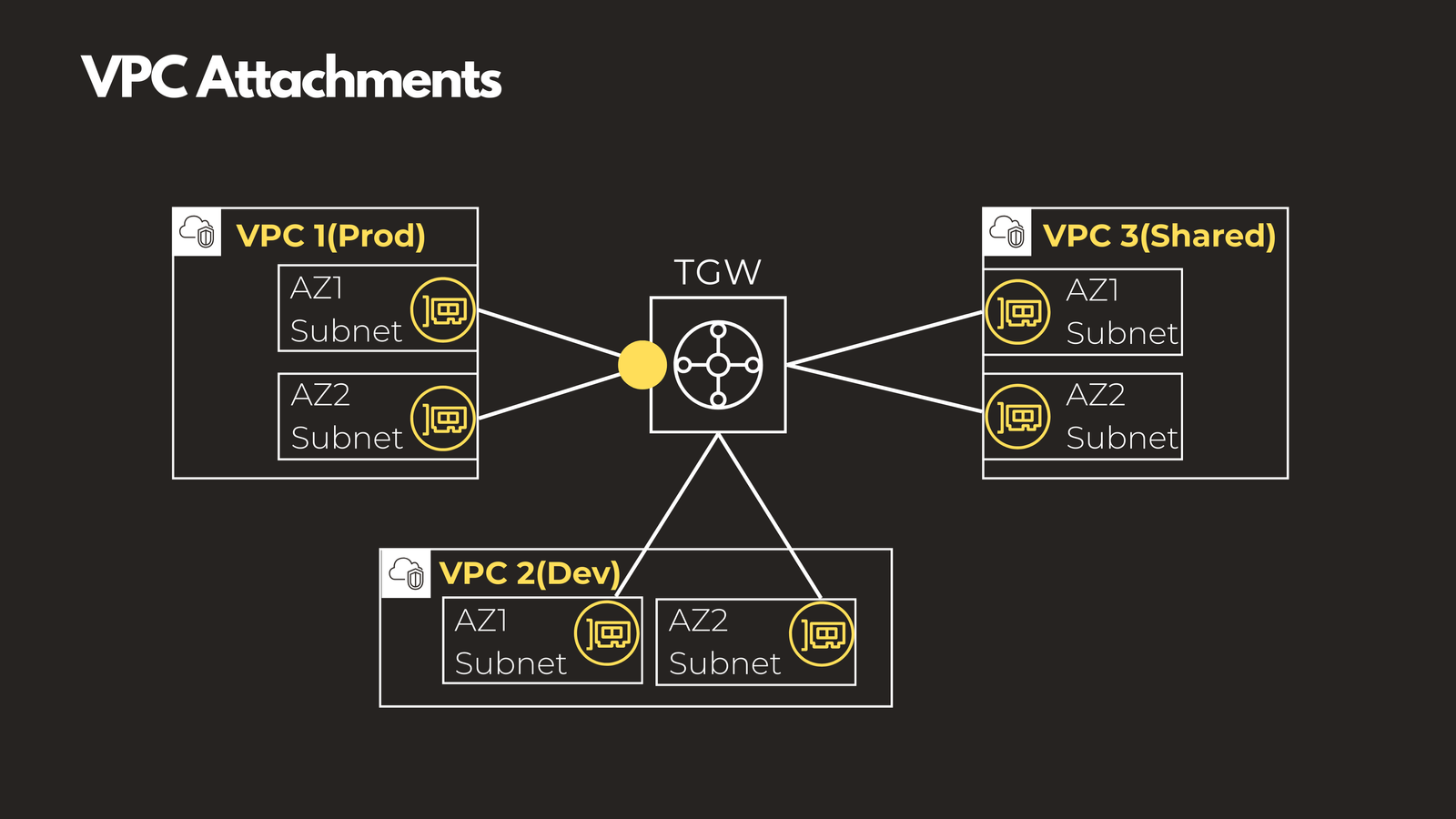
When connecting a VPC to Transit Gateway, you select specific subnets in each Availability Zone where you want connectivity. Transit Gateway then creates Elastic Network Interfaces (ENIs) in those subnets, and traffic flows through these interfaces to reach other attached resources.
Real-world use case:
Imagine you have three VPCs: Production, Development, and Shared Services. Rather than creating a complex mesh of VPC peering connections between each pair, you can attach all three VPCs to a single Transit Gateway. This provides centralized connectivity, simplified routing, and easier management as your infrastructure grows.
Benefits:
- Eliminates the complexity of managing multiple peering connections
- Provides a scalable architecture that grows with your needs
- Centralizes network routing and policy enforcement
VPN Attachments: Secure Internet-Based Connectivity
VPN attachments connect your on-premises networks to Transit Gateway using encrypted IPSec VPN tunnels over the internet.
How VPN attachments work:
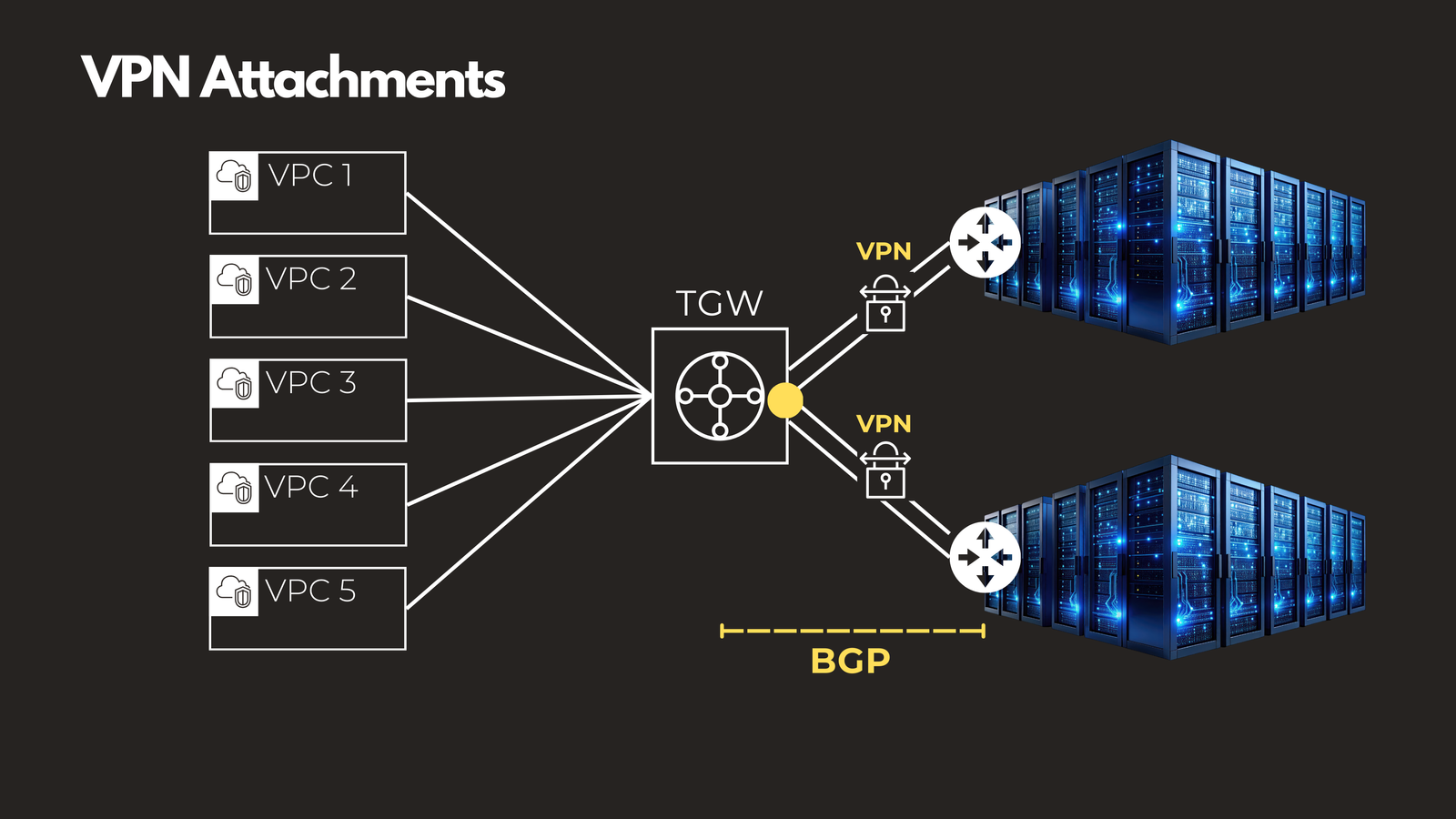
You create a Site-to-Site VPN connection that attaches directly to Transit Gateway, pointing to your on-premises customer gateway. AWS automatically provisions two VPN tunnels for redundancy, ensuring high availability. Once the VPN is established, all VPCs attached to the Transit Gateway can communicate with your on-premises network.
Key features:
- Automatic failover using BGP (Border Gateway Protocol)
- ECMP (Equal-Cost Multi-Path) support for increased bandwidth
- Centralized VPN management for multiple VPCs
Real-world use case:
If your company headquarters needs access to multiple AWS VPCs—perhaps for different departments or applications—a single VPN attachment to Transit Gateway can serve all of them. There’s no need to establish separate VPN connections for each VPC, dramatically simplifying your network architecture.
Direct Connect Gateway Attachments: Enterprise-Grade Private Connectivity
When internet-based VPN connectivity doesn’t meet your performance or reliability requirements, Direct Connect Gateway attachments provide a private, dedicated connection from your on-premises infrastructure to Transit Gateway.
Why choose Direct Connect Gateway attachments:
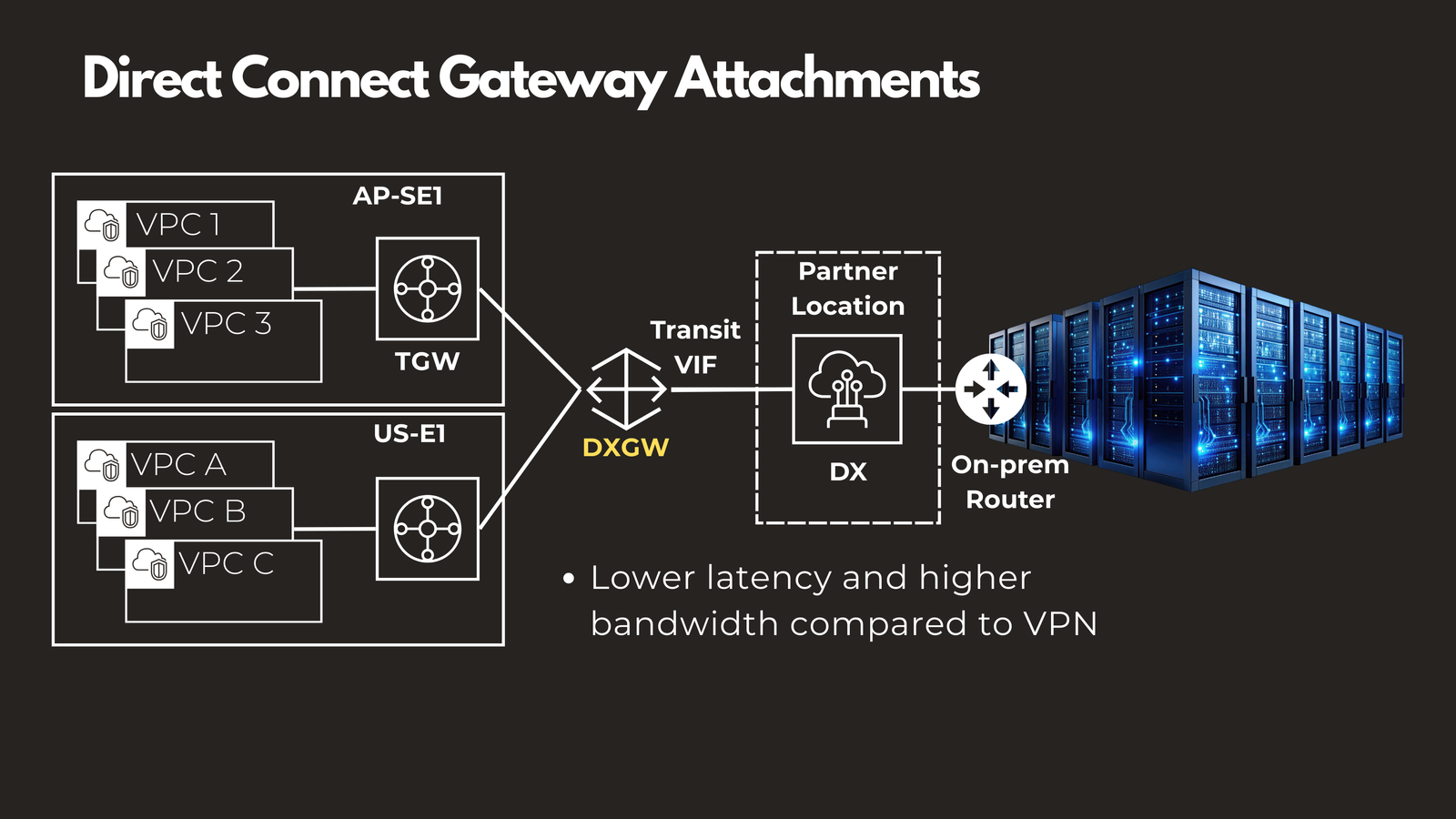
Direct Connect offers significantly lower latency and higher bandwidth compared to VPN connections, making it ideal for workloads with demanding performance requirements or large data transfer needs.
How it works:
You connect your existing Direct Connect circuit to a Direct Connect Gateway, then attach that gateway to your Transit Gateway. This configuration provides private connectivity from all attached VPCs to your on-premises network through a single Direct Connect connection.
Real-world use case:
Organizations running hybrid cloud architectures with heavy data transfer requirements—such as large database replications, big data analytics, or media processing workflows—benefit greatly from Direct Connect Gateway attachments. One Direct Connect circuit can efficiently serve all your VPCs through Transit Gateway, maximizing your infrastructure investment.
Peering Attachments: Connecting Transit Gateways
As your AWS footprint expands across multiple regions or you need to segment traffic within a region, peering attachments enable you to connect Transit Gateways together.
Two types of peering attachments:
Intra-region peering: Connects Transit Gateways within the same AWS region, useful for creating segmented network domains while maintaining the ability to route between them when needed.
Inter-region peering: Connects Transit Gateways across different AWS regions, enabling global network architectures.
Real-world use case:
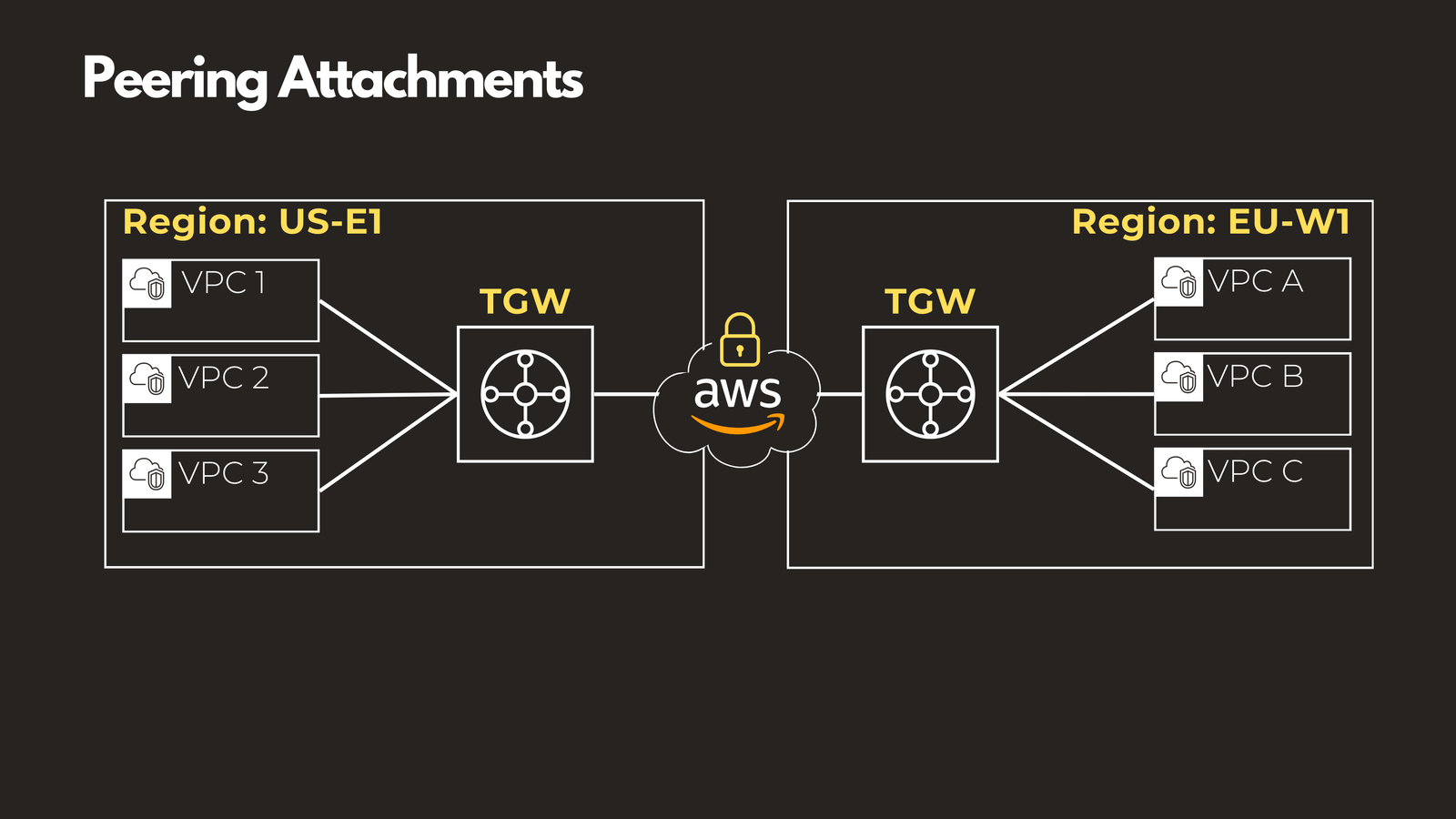
Consider a multinational company with infrastructure in both US and European AWS regions. Each region has its own Transit Gateway connecting local VPCs. By creating an inter-region peering attachment between these Transit Gateways, you enable VPCs in the US to communicate with VPCs in Europe.
Key advantage:
Traffic between regions travels over the AWS backbone network rather than the public internet. This inter-region traffic is automatically encrypted, providing both better performance and enhanced security.
Connect Attachments: SD-WAN Integration
The newest addition to Transit Gateway attachment types, Connect attachments enable integration with third-party SD-WAN (Software-Defined Wide Area Network) solutions.
How Connect attachments work:
Connect attachments use GRE (Generic Routing Encapsulation) tunnels and BGP to integrate SD-WAN appliances with Transit Gateway. To use a Connect attachment, you must first have an existing VPC attachment or Direct Connect Gateway attachment as the underlying transport. The Connect attachment then creates GRE tunnels from Transit Gateway to your third-party SD-WAN appliance.
Key features:
- BGP peering for automatic failover and dynamic routing
- Higher throughput compared to traditional IPSec VPNs
- Native integration with popular SD-WAN vendors like Cisco and VMware
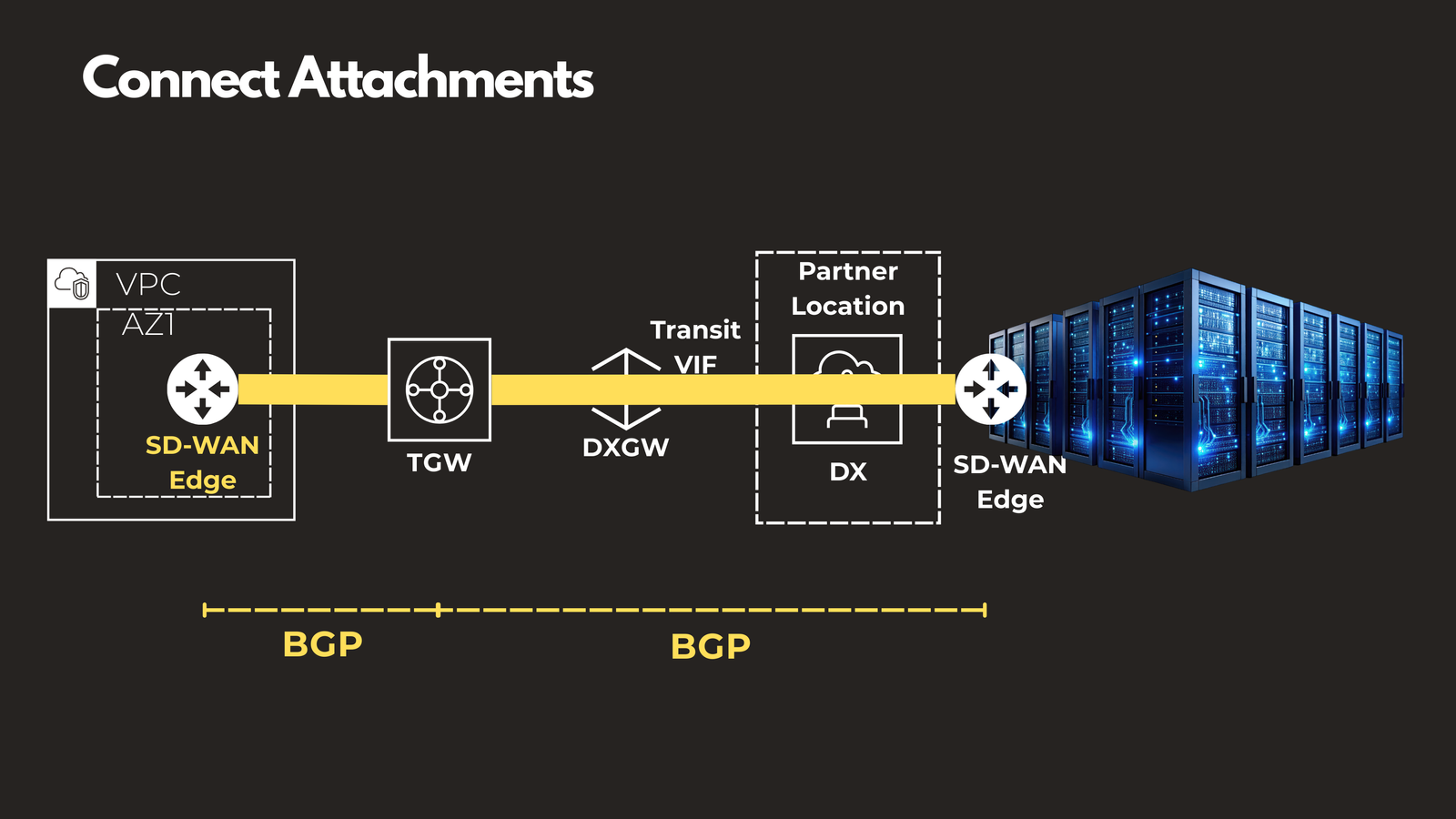
Real-world use case:
If your organization has standardized on a third-party SD-WAN solution for branch office connectivity, Connect attachments allow you to extend that SD-WAN fabric into AWS. You can leverage existing BGP peering between your branch locations and AWS VPCs, creating a unified network architecture with optimized routing and performance.
Choosing the Right Attachment Type
Selecting the appropriate Transit Gateway attachment depends on several factors:
For connecting AWS VPCs:
- Use VPC attachments for any VPCs that need to communicate through Transit Gateway
For on-premises connectivity:
- Use VPN attachments when cost-effectiveness and quick deployment are priorities, and internet-based performance is acceptable
- Choose Direct Connect Gateway attachments when you need consistent high performance, low latency, or transfer large volumes of data
For multi-region or segmented architectures:
- Use peering attachments to connect Transit Gateways within the same region or across different regions
For SD-WAN integration:
- Use Connect attachments when integrating third-party SD-WAN solutions with your AWS infrastructure
Important consideration: While attachments provide the physical connections between resources, remember that routing policies and route tables determine how traffic actually flows. Proper route configuration is essential to achieving your desired traffic patterns.
Architecture Best Practices
When designing your Transit Gateway attachment strategy, consider these best practices:
- Plan for redundancy: Always configure multiple tunnels or connections for critical workloads
- Use BGP for dynamic routing: BGP provides automatic failover and optimal path selection
- Segment traffic appropriately: Use multiple Transit Gateway route tables to isolate different types of traffic
- Monitor bandwidth utilization: Ensure your attachments can handle your traffic volumes
- Consider costs: Different attachment types have different pricing models—balance performance needs with budget constraints
Conclusion
Transit Gateway attachments are the building blocks of scalable, efficient AWS network architectures. By understanding when and how to use VPC attachments, VPN attachments, Direct Connect Gateway attachments, peering attachments, and Connect attachments, you can design networks that meet your organization’s specific connectivity, performance, and cost requirements.
Whether you’re connecting a handful of VPCs or building a global hybrid cloud infrastructure with SD-WAN integration, Transit Gateway attachments provide the flexibility and scalability needed to support your evolving business needs.
Have questions about AWS Transit Gateway Attachments? Check out the video on this link https://youtu.be/J4wyr8B_TfE, drop a comment and let’s discuss!