 Packetbrew
EtherChannel Explained: Bundling Links for More Bandwidth and Redundancy
If you’ve ever worked with Layer 2 networks, you know the frustration of Spanning Tree Protocol (STP) blocking links to prevent loops. Those blocked links sit idle, wasting bandwidth and leaving redundancy potential on the table. Fortunately, EtherChannel offers a powerful solution — and in this post, we’re breaking it all down.
By the end of this guide, you’ll understand what EtherChannel is, how its negotiation protocols work, what configuration requirements you need to meet, and when to use it in the real world.
What Is EtherChannel?
EtherChannel is a link aggregation technology that bundles multiple physical network links into a single logical interface called a Port-Channel. Instead of STP blocking redundant links, EtherChannel makes use of all of them simultaneously.
Here’s why that matters: if you bundle four 1 Gbps links into a single EtherChannel, you get a logical interface with 4 Gbps of total bandwidth. And if one link fails, traffic automatically fails over to the remaining links — no manual intervention needed.
Key facts about EtherChannel:
- Bundles multiple physical links into one logical Port-Channel interface
- Aggregates bandwidth across all bundled links
- Enables load balancing of traffic across member links
- Provides automatic failover if a member link goes down
- Supports up to 8 links per bundle (varies by platform)
- Can be configured as Layer 2 (switched) or Layer 3 (routed) interface
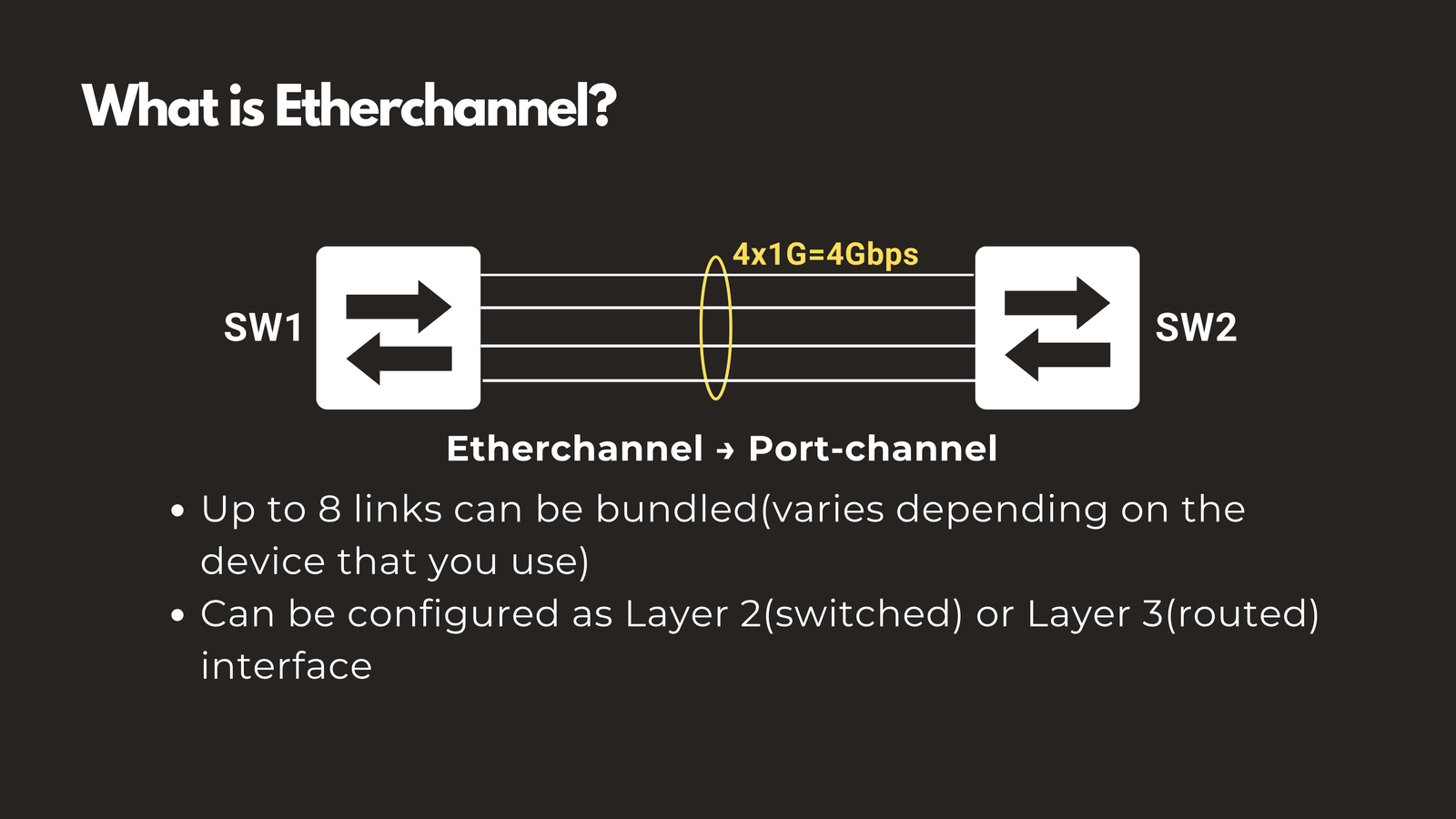
Think of EtherChannel like lanes on a highway — more lanes means more traffic can flow, and if one lane closes, traffic simply shifts to the others.
EtherChannel Negotiation Protocols
EtherChannel uses negotiation protocols to dynamically detect and form link bundles between devices. There are two main protocols, plus a static option:
1. Link Aggregation Control Protocol(LACP)
Standard: IEEE 802.3ad (open standard, vendor-neutral)
LACP is the preferred protocol for most environments because it works across different vendors. It has two modes:
- Active: The port actively initiates LACP negotiation with the peer.
- Passive: The port waits and responds to LACP negotiation, but does not initiate.
2. Port Aggregation Protocol(PAgP)
Standard: Cisco proprietary
PAgP is Cisco’s own protocol and works only between Cisco devices. It also has two modes:
- Desirable: The port actively initiates PAgP negotiation (equivalent to LACP Active).
- Auto: The port responds to PAgP negotiation but does not initiate (equivalent to LACP Passive).
3. Static Mode (On)
In static mode, the EtherChannel is formed without any negotiation protocol. Both sides must be set to “On” manually.
Protocol Quick Reference
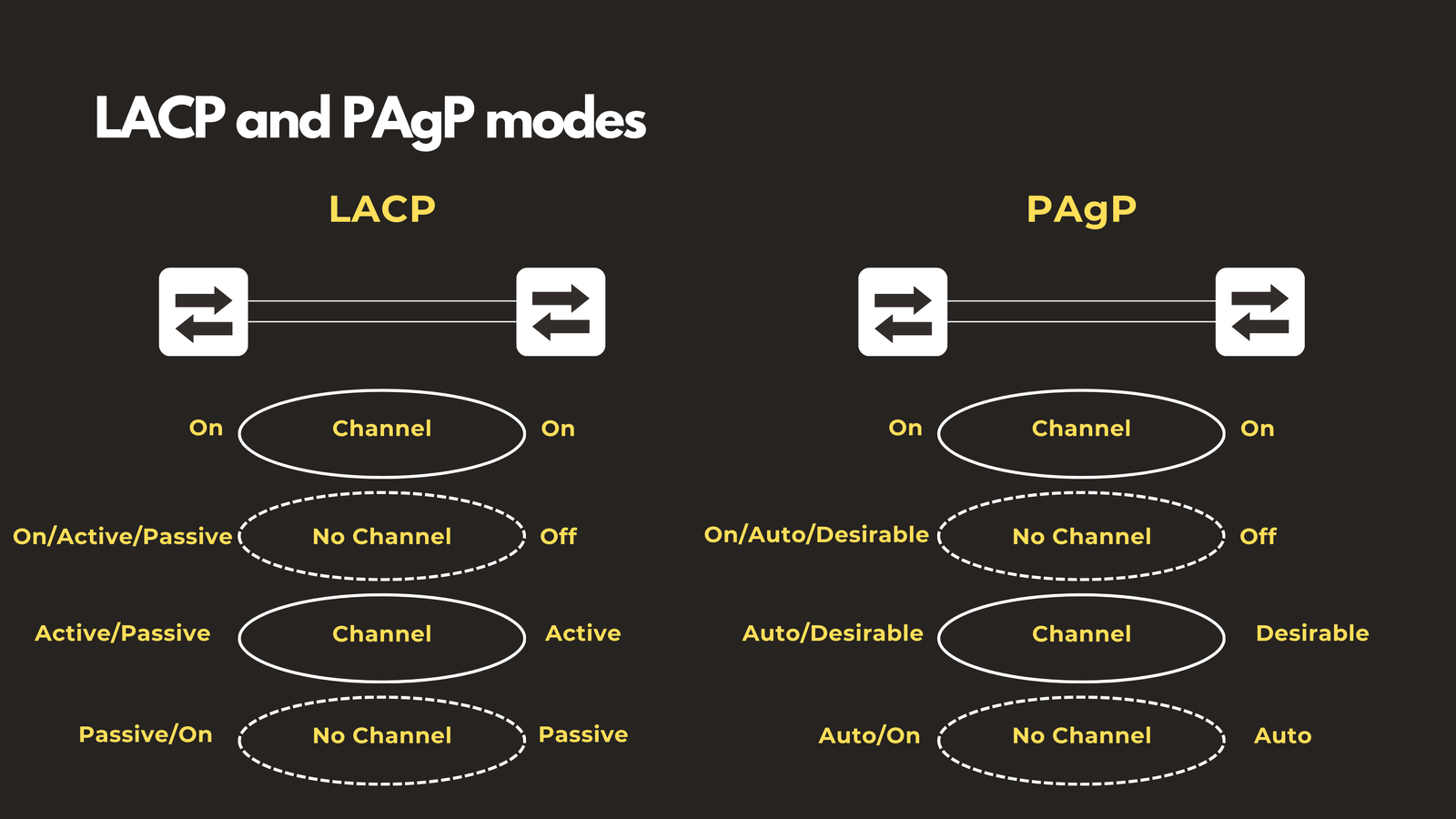
For LACP to form a channel, at least one side must be Active. For PAgP, at least one side must be Desirable.
Best practice: Use LACP in multi-vendor environments. Reserve PAgP for Cisco-only setups, and avoid static ‘On’ mode unless absolutely necessary.
EtherChannel Configuration Requirements
EtherChannel won’t form a Port-Channel if the member ports have mismatched settings. All physical interfaces included in the bundle must share identical configuration across the following parameters:
- Speed and Duplex: All interfaces must run at the same speed and duplex setting. Full-duplex is the default on most modern interfaces.
- Switchport Mode: All ports must be consistently configured as either access ports or trunk ports — you can’t mix them.
- VLAN Configuration: Trunk ports must share the same native VLAN and allowed VLAN ranges. Access ports must be in the same VLAN.
- Protocol Consistency: All interfaces must use the same negotiation protocol — LACP, PAgP, or static On mode.
- Layer 2 or Layer 3: You cannot mix Layer 2 and Layer 3 interfaces in the same EtherChannel. All ports must be one or the other.
Sample Configuration
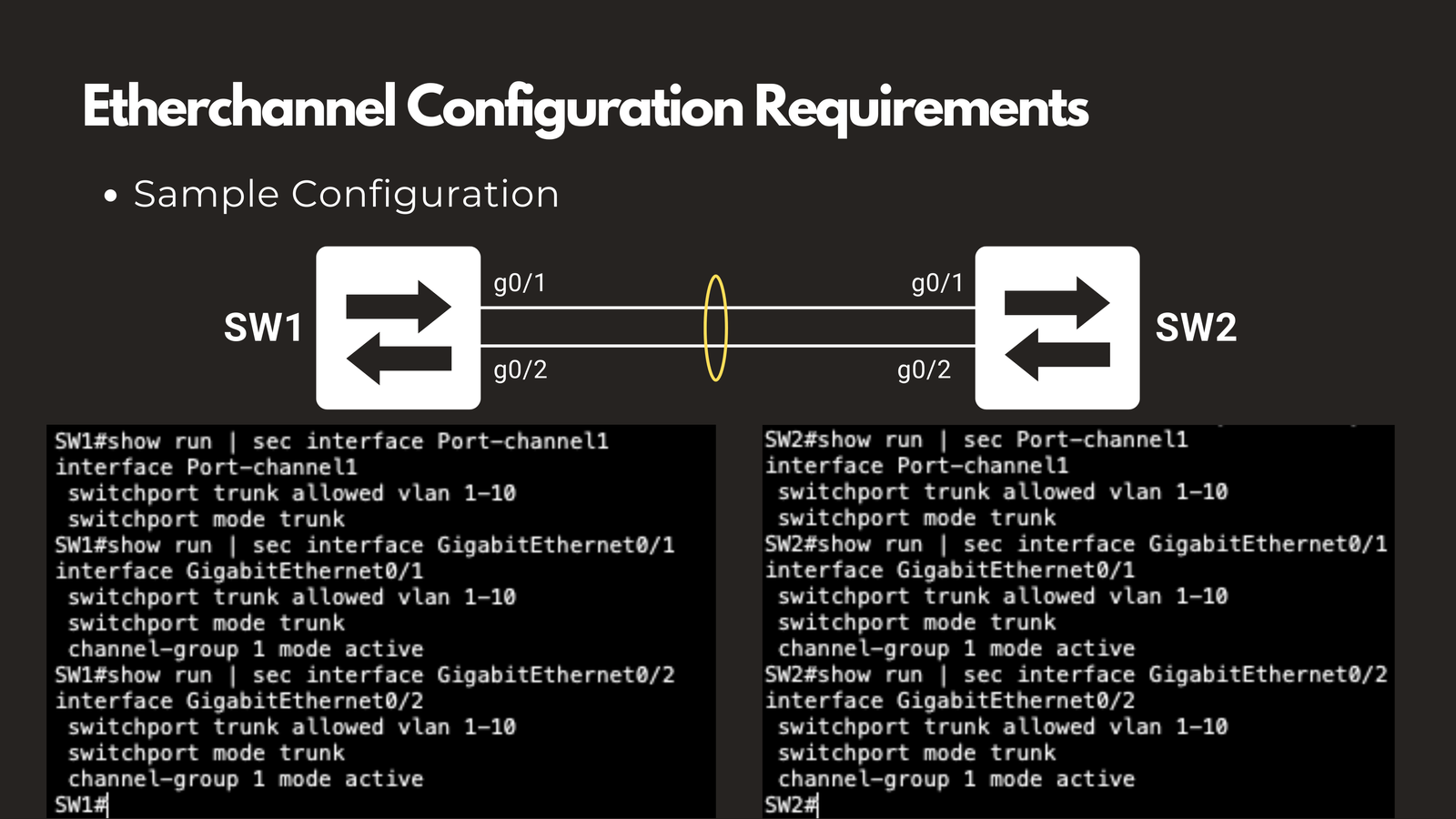
Always verify your configuration on BOTH ends of the link before bringing up an EtherChannel. A mismatch on either side will prevent the bundle from forming.
Real-World Use Cases
EtherChannel is flexible enough to fit a variety of network designs. Here are the most common scenarios where it shines:
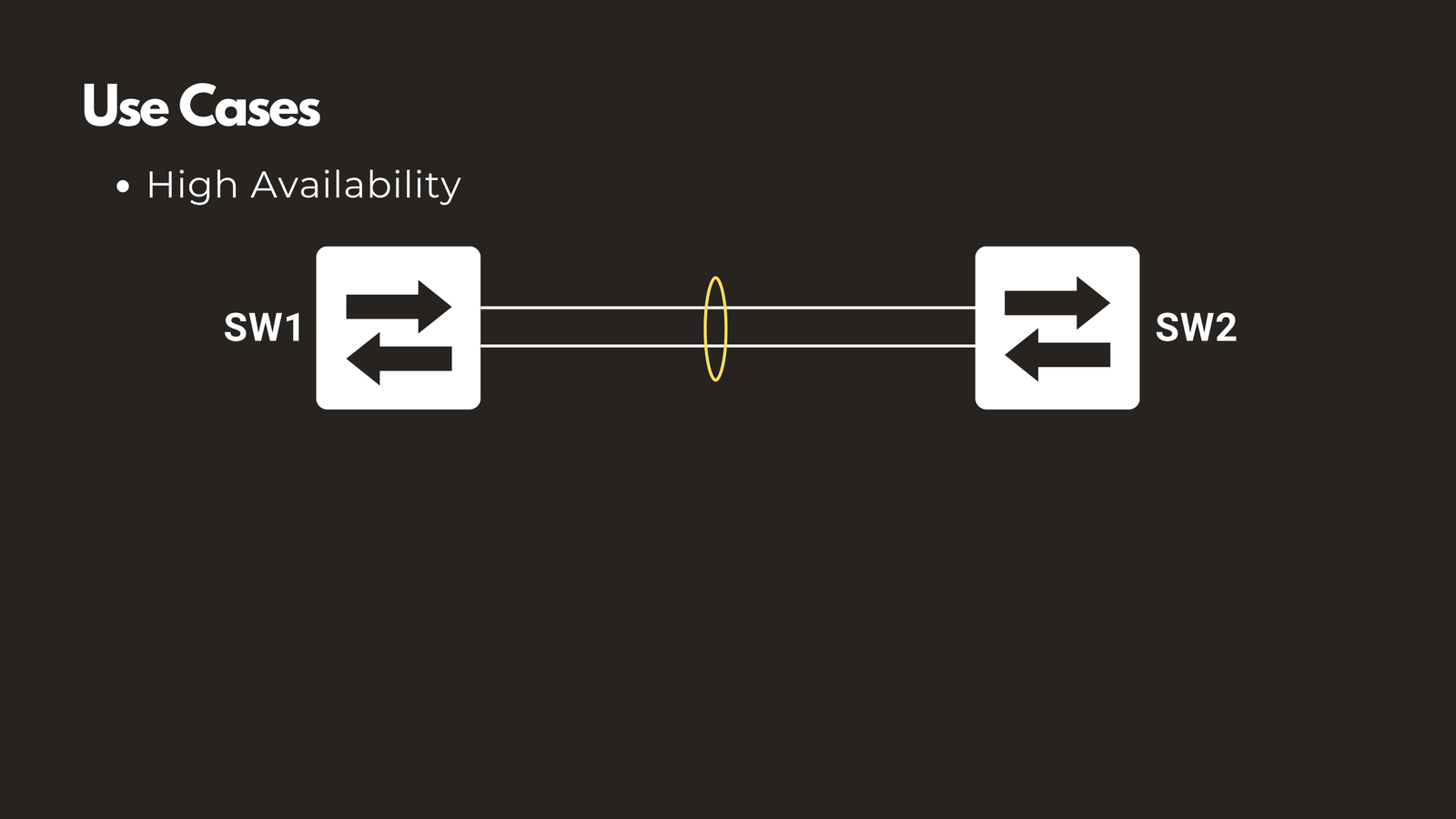
Basic Switch-to-Switch Bundling
The simplest and most common use case: bundle multiple uplinks between two switches to increase throughput and provide redundancy. If any one link fails, the others keep traffic flowing without interruption.
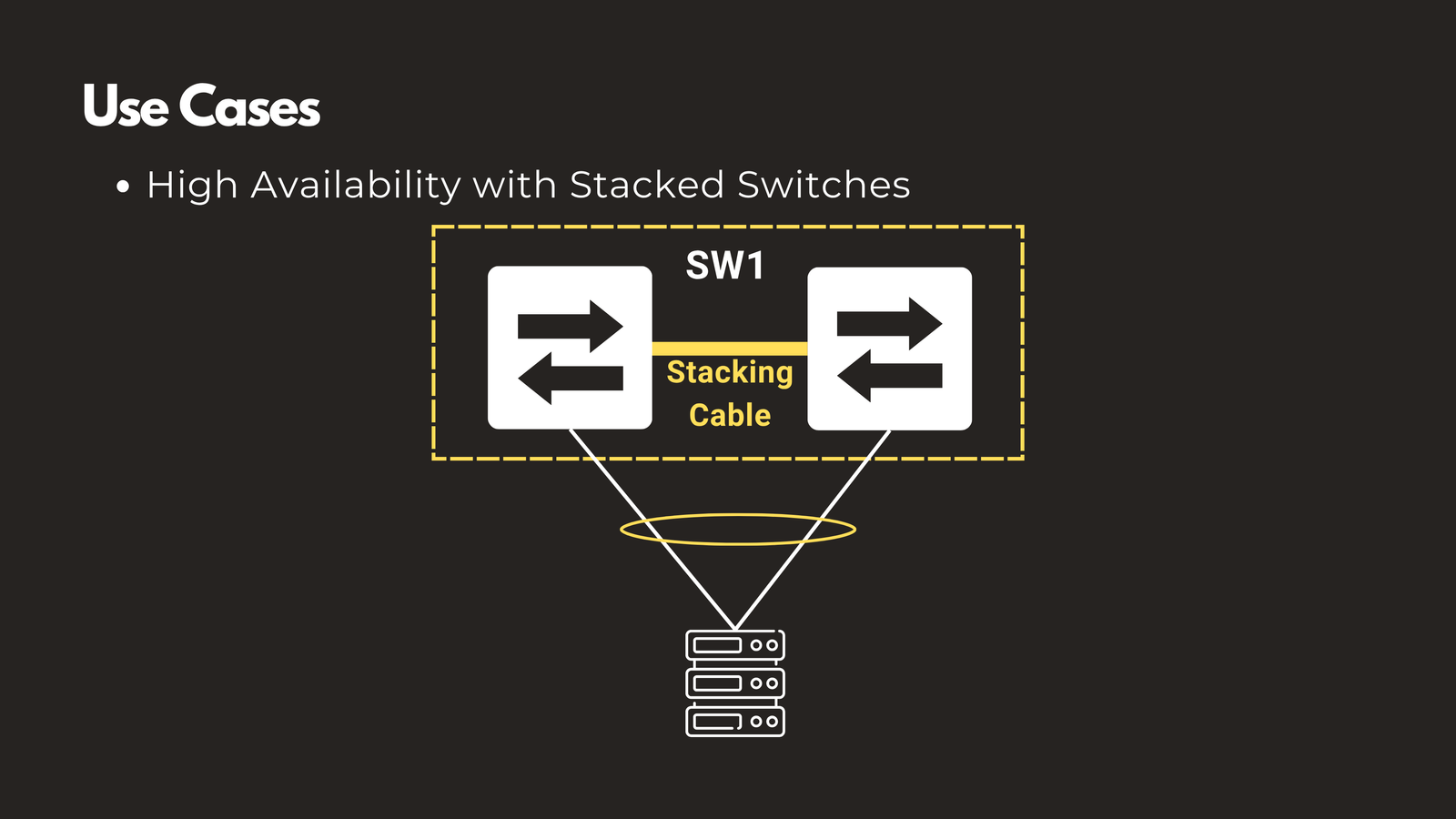
Stacked Switches
With switch stacking (e.g., Cisco StackWise), multiple physical switches are treated as a single logical switch. You can form an EtherChannel across the stack — one port per stack member — giving you both aggregated bandwidth and device-level redundancy.
Multi-Chassis Link Aggregation (mLAG)
Technologies like Cisco’s Virtual Port Channel (vPC) on Nexus switches or VSS on Catalyst switches allow two separate physical switches to act as one logical switch for EtherChannel purposes. This is achieved using dedicated peer links and keepalive connections rather than stacking cables.
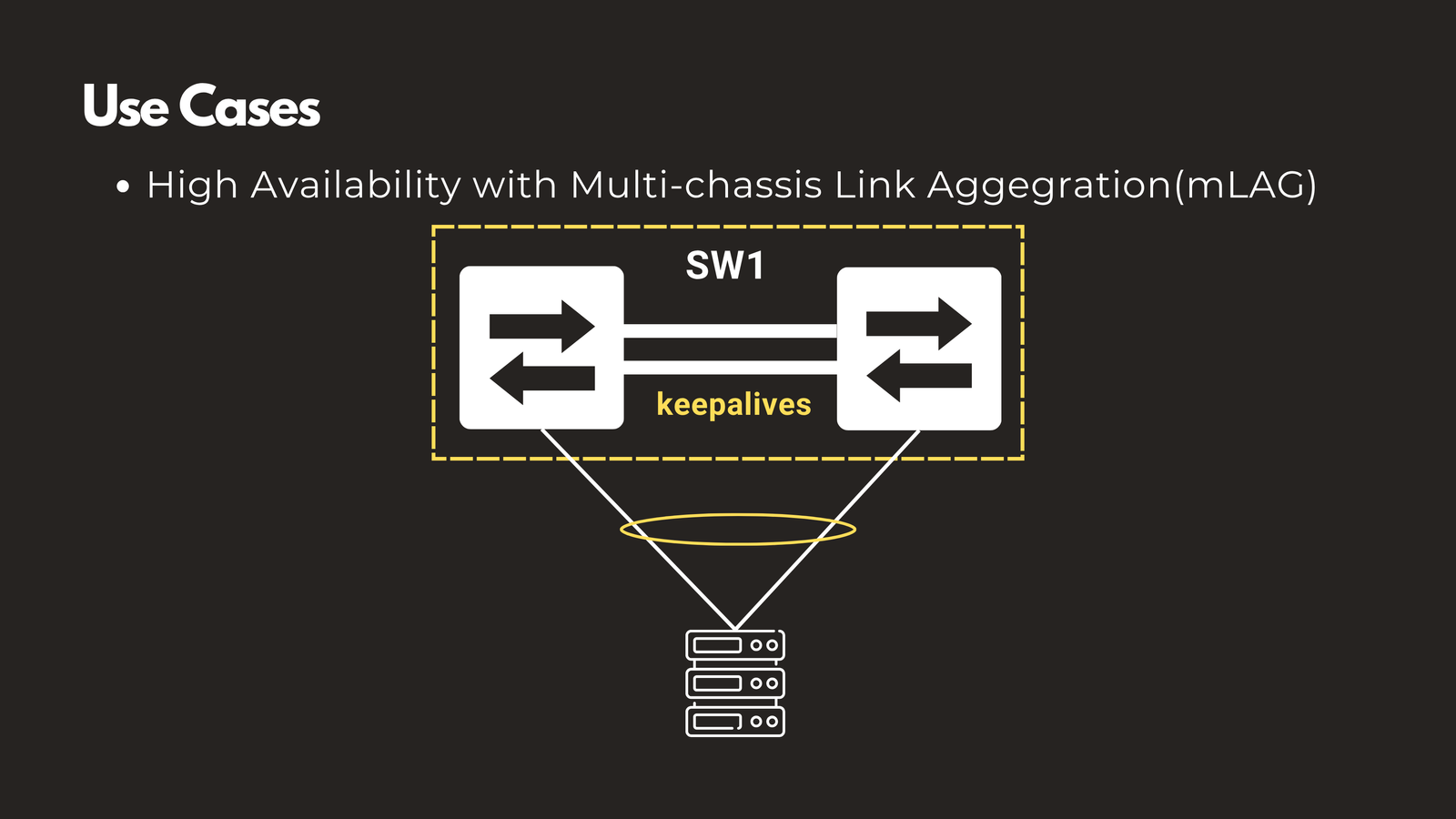
The benefit: if an entire switch fails, the EtherChannel remains operational through the surviving switch — providing true device-level redundancy without STP involvement.
mLAG and stacking are particularly powerful in data center and campus core designs where maximum uptime is critical.
Wrapping Up
EtherChannel is one of the most practical tools in a network engineer’s toolkit. By bundling physical links into a single logical interface, you get more bandwidth, built-in redundancy, and seamless failover — all without the limitations of Spanning Tree Protocol blocking your links.
Here’s a quick recap of what we covered:
- EtherChannel bundles links into a Port-Channel for increased bandwidth and redundancy
- LACP (IEEE open standard) and PAgP (Cisco proprietary) are the two negotiation protocols
- All member ports must match in speed, duplex, mode, VLANs, and Layer 2/3 type
- Use cases range from simple switch uplinks to multi-chassis designs like vPC and VSS
Have questions about Etherchannel? Check out the video on this link https://youtu.be/q96g5z9psrI, drop a comment and let’s discuss!