 Packetbrew
Layer 2 Technologies: Every Ethernet Switching Term That You Need to Know
Modern network infrastructure relies heavily on Layer 2 switching technologies to efficiently move data across enterprise networks. Whether you’re preparing for network certification or building real-world networks, understanding these fundamental concepts is crucial for any network professional.
In this comprehensive guide, we’ll explore the essential Layer 2 technologies that form the backbone of modern Ethernet networks, from basic VLANs to advanced spanning tree protocols.
Virtual LANs (VLANs): Segmenting Your Network
Understanding VLAN Fundamentals
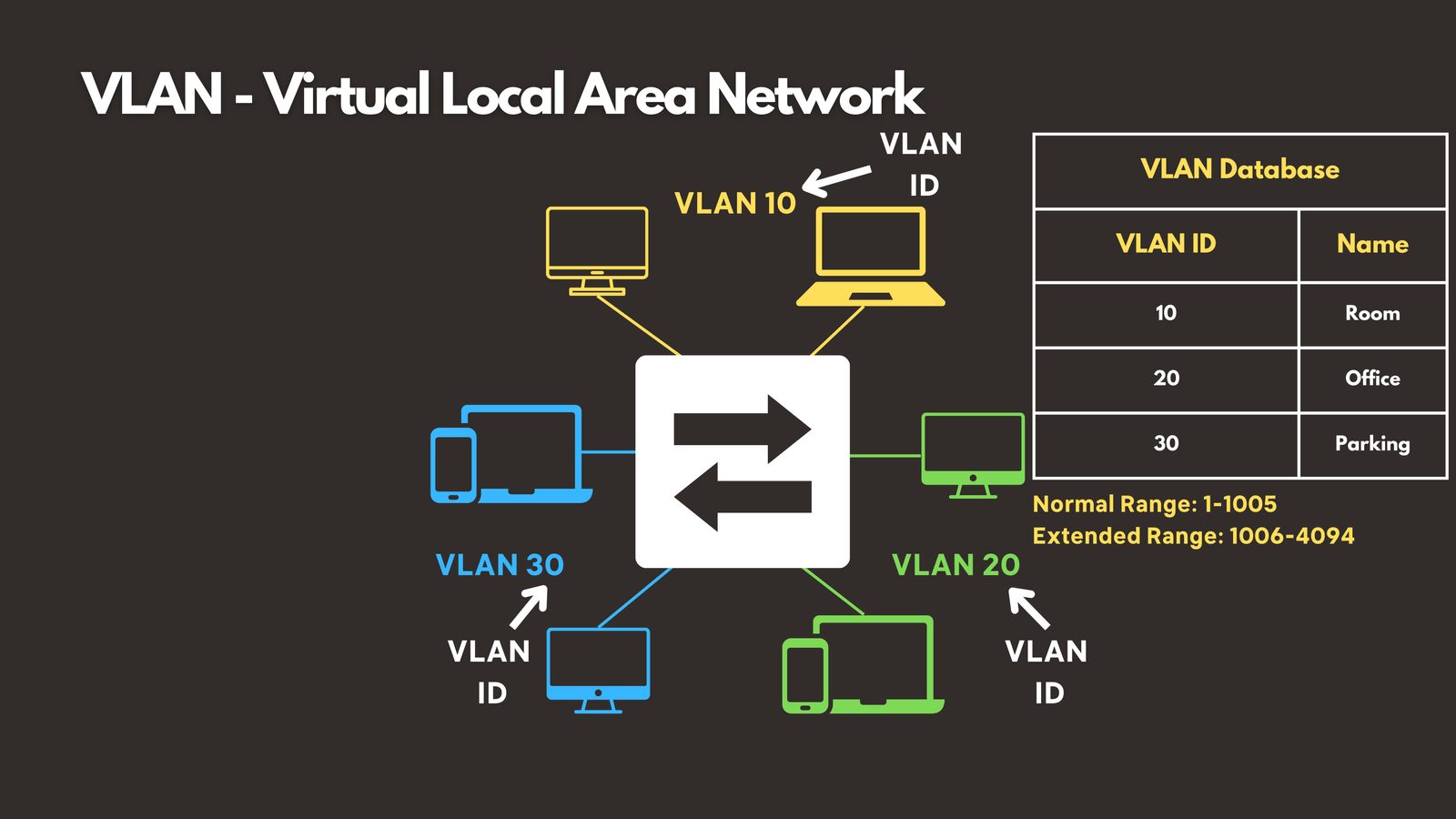
Virtual Local Area Networks (VLANs) revolutionized network design by allowing logical segmentation of broadcast domains without requiring physical separation. Instead of dedicating separate switches for different departments, VLANs let you create isolated network segments on the same physical infrastructure.
VLAN Types and Ranges:
- Normal range VLANs (1-1005): Stored in the VLAN database, these are the most commonly used VLANs in enterprise networks
- Extended range VLANs (1006-4094): Stored in running configuration, typically used in larger enterprise deployments
Each VLAN is identified by a unique VLAN ID (VID), which determines how switches handle frame forwarding and broadcast domain containment.
Access Ports: Connecting End Devices
Access ports represent the most common switch port configuration, connecting end devices like computers, printers, and IP phones to the network. These ports belong to a single VLAN and handle both data and voice traffic efficiently.
Key Access Port Concepts:
- Data VLAN: Carries regular network traffic for connected devices
- Voice VLAN: For IP phone communications
- Default VLAN: VLAN 1 serves as the factory default for all switch ports
The beauty of access ports lies in their simplicity – end devices don’t need to understand VLAN tagging, as the switch handles all VLAN assignment automatically.
Trunk Links: Connecting Switches
The Power of Trunking
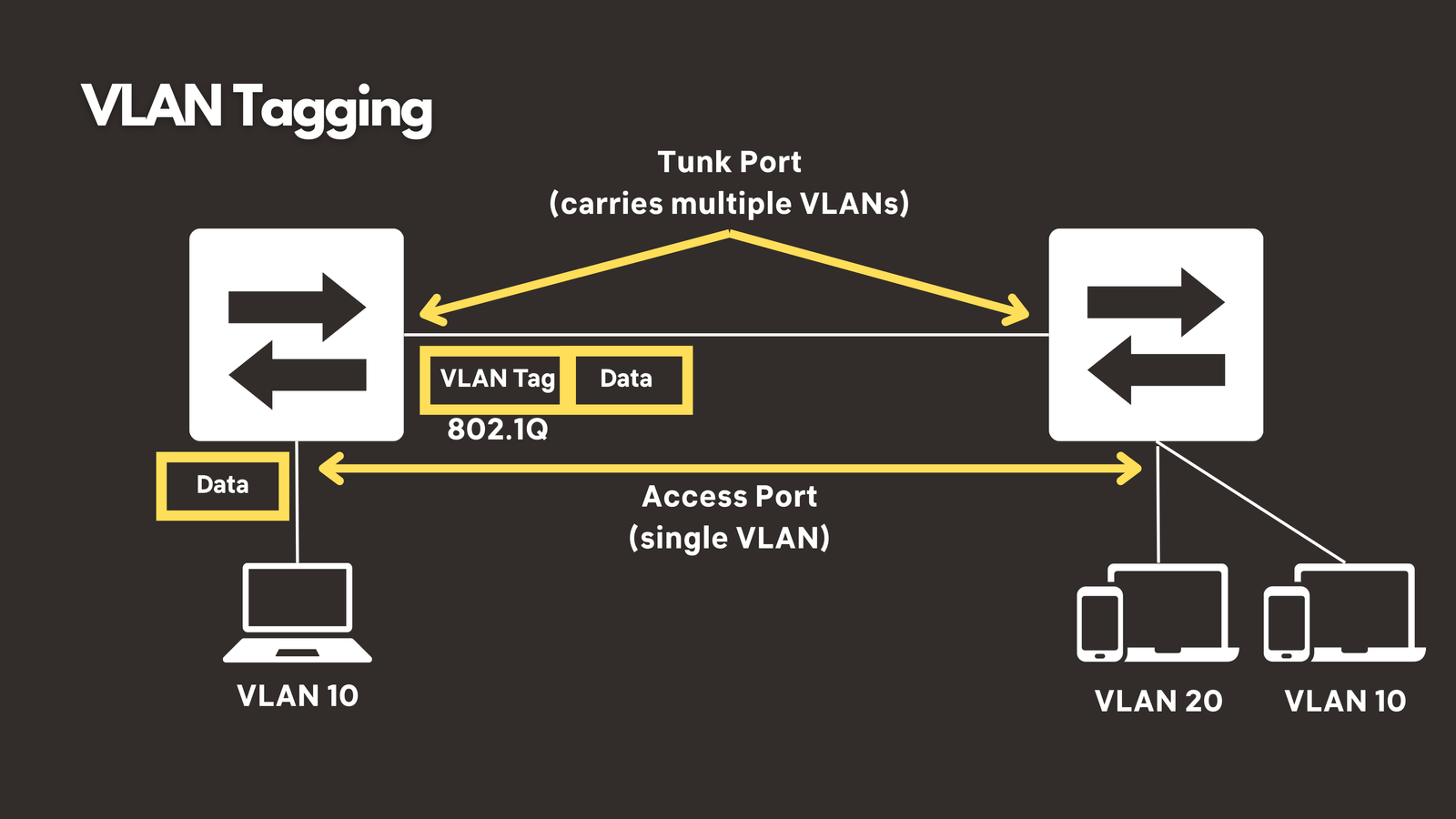
Trunk ports solve a critical networking challenge: how do you carry traffic for multiple VLANs over a single physical link? Without trunking, you’d need separate physical connections for each VLAN between switches – clearly impractical in large networks.
Trunk Fundamentals:
- Tagged frames: Include VLAN identification information
- Untagged frames: Belong to the native VLAN
- VLAN tagging: The process of adding VLAN information to Ethernet frames
802.1Q: The Standard for VLAN Tagging
The IEEE 802.1Q standard defines how VLAN information is embedded into Ethernet frames. This 4-byte VLAN tag is inserted into the frame header, allowing switches to identify which VLAN the frame belongs to.
Native VLAN Considerations
The native VLAN deserves special attention in trunk configuration. Traffic for the native VLAN travels untagged across trunk links, which can create both convenience and security considerations. Most network engineers recommend changing the native VLAN from the default VLAN 1 to an unused VLAN for security purposes.
Inter-VLAN Routing
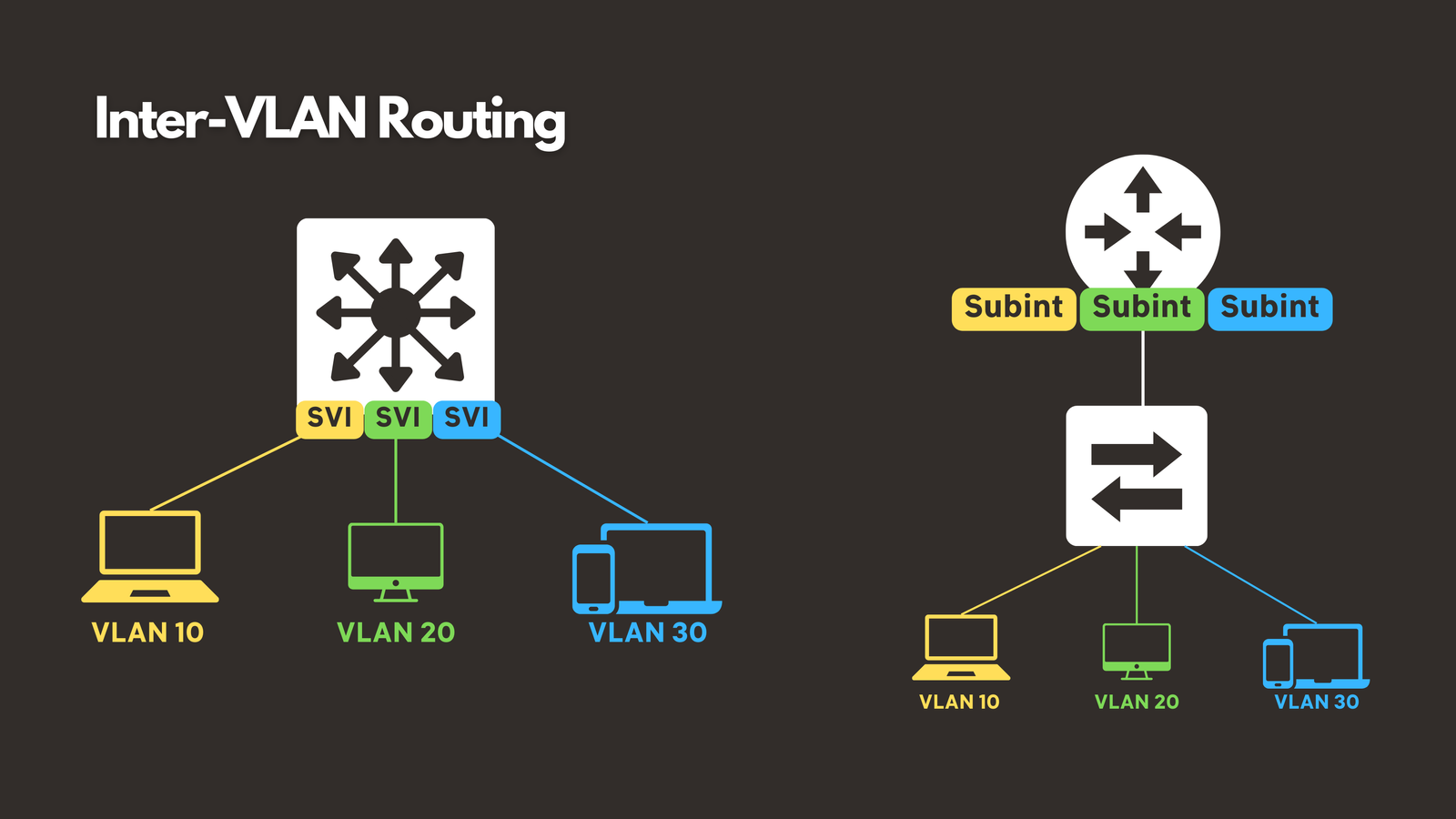
While VLANs excel at segmenting traffic, business requirements often demand communication between different VLANs. This is where InterVLAN routing comes into play.
Popular Inter-VLAN Solutions:
- Router-on-a-stick: Uses subinterfaces on a single physical router interface
- Multilayer switches: Combine switching and routing functionality in one device. Uses Switched Virtual Interfaces (SVIs), Layer 3 VLAN interfaces on multilayer switches
Each approach has its merits, with multilayer switches becoming increasingly popular in modern enterprise networks due to their performance and management benefits.
Discovery Protocols: Network Documentation Made Easy
Cisco Discovery Protocol (CDP)
CDP provides automatic neighbor discovery for Cisco devices, sending periodic advertisements containing device information like hostname, IP addresses, and platform details. This proprietary protocol simplifies network documentation and troubleshooting.
Link Layer Discovery Protocol (LLDP)
LLDP offers similar functionality to CDP but follows the IEEE 802.1AB standard, making it vendor-neutral. This standardization makes LLDP increasingly popular in multi-vendor environments.
Both protocols are invaluable for network documentation, troubleshooting, and understanding network topology without manually tracking every connection.
EtherChannel: Multiplying Your Bandwidth
Link Aggregation Fundamentals
EtherChannel technology addresses the bandwidth limitations of individual links by bundling multiple physical connections into a single logical channel. This approach provides both increased bandwidth and redundancy without the complexity of routing protocols.
EtherChannel Benefits:
- Increased bandwidth: Aggregate bandwidth of all member links
- Load balancing: Traffic distributed across available links
- Redundancy: Automatic failover if member links fail
- Simplified management: Single logical interface to configure
LACP vs PAgP: Choosing Your Negotiation Protocol
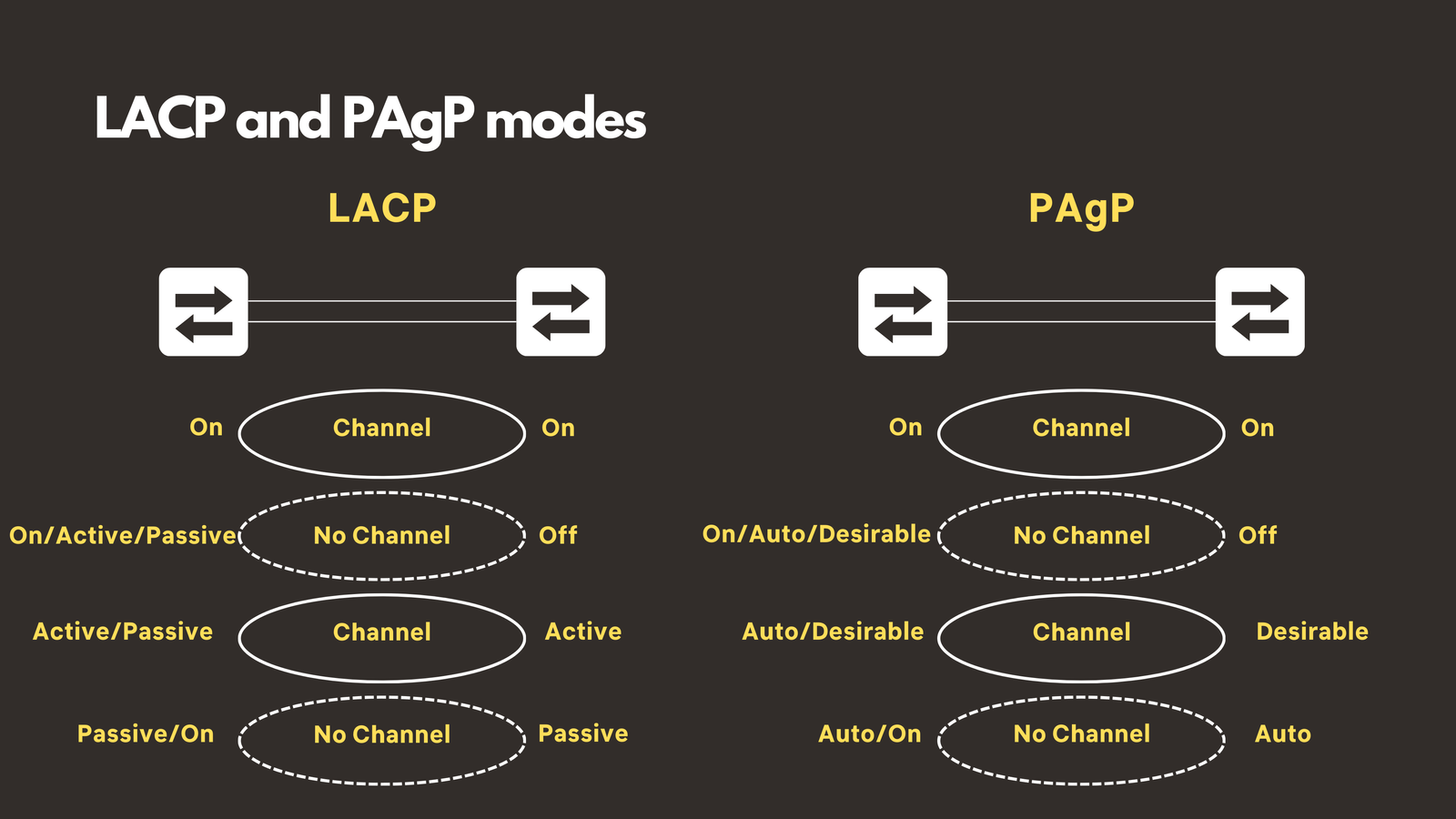
Two protocols handle dynamic EtherChannel formation:
LACP (Link Aggregation Control Protocol):
- IEEE 802.3ad standard (vendor-neutral)
- Active mode: Actively initiates negotiation
- Passive mode: Responds to negotiation attempts
PAgP (Port Aggregation Protocol):
- Cisco proprietary protocol
- Desirable mode: Actively initiates negotiation
- Auto mode: Responds to negotiation attempts
LACP’s vendor-neutral nature makes it the preferred choice in mixed-vendor environments, while PAgP remains viable in pure Cisco networks.
Spanning Tree Protocol: Preventing Network Loops
The Loop Prevention Challenge
Layer 2 networks require redundant paths for fault tolerance, but these same redundant paths create the potential for devastating broadcast storms. Spanning Tree Protocol (STP) elegantly solves this dilemma by maintaining redundancy while preventing loops.
Rapid PVST+: Cisco’s STP Implementation
Rapid Per-VLAN Spanning Tree Plus (Rapid PVST+) combines the benefits of rapid convergence with per-VLAN optimization. This implementation runs a separate spanning tree instance for each VLAN, allowing for optimal path selection and load balancing.
Key STP Components:
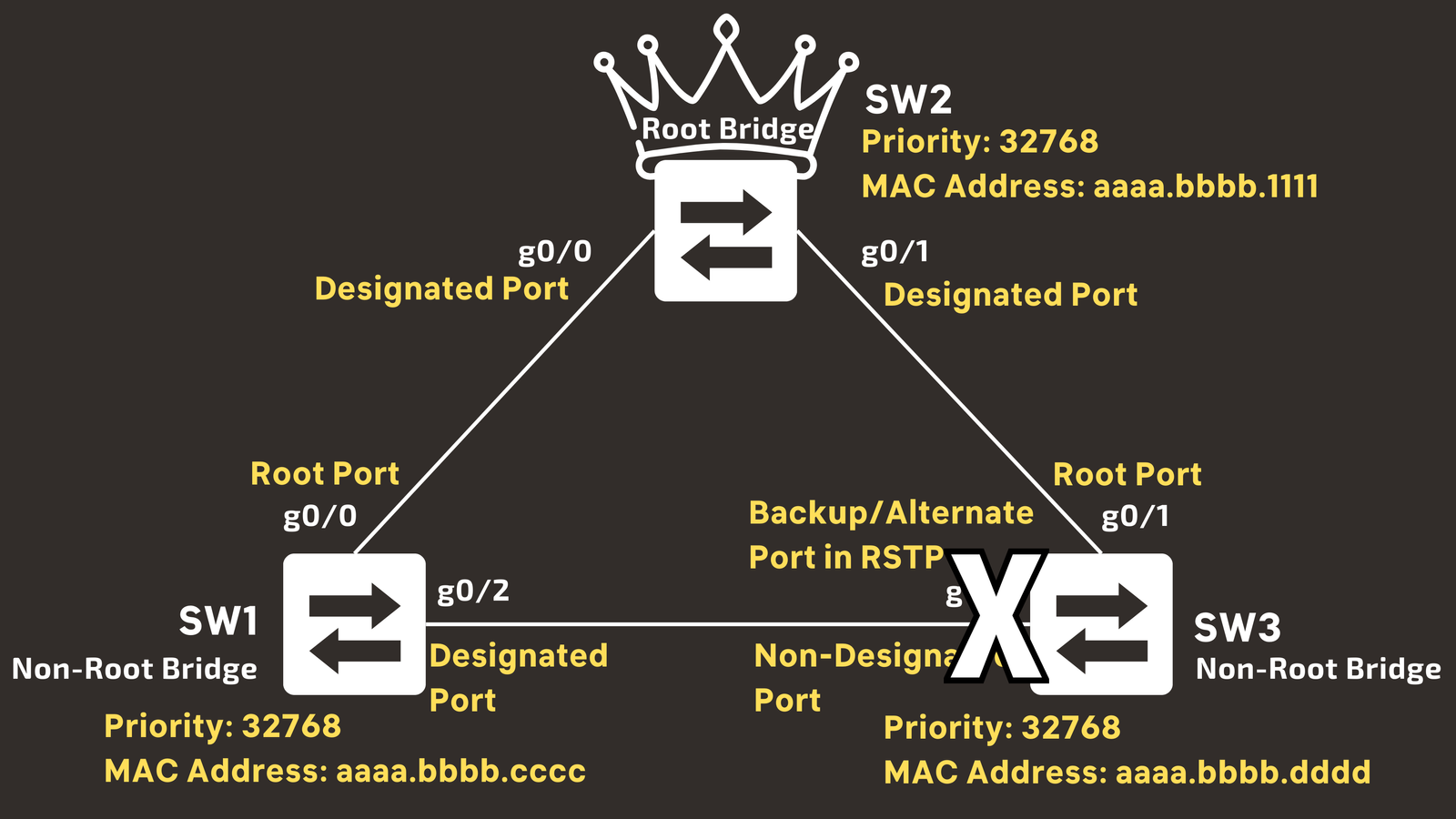
- Bridge Protocol Data Units (BPDUs): Control messages that coordinate STP operation
- Bridge ID: Combines bridge priority and MAC address for root bridge election
- Root bridge: Central reference point for the spanning tree topology
Port Roles and States
Understanding port roles and states is crucial for STP troubleshooting:
Port Roles:
- Root port: Best path to root bridge on non-root switches
- Designated port: Forwarding port for each network segment
- Blocked port: Prevents loops by not forwarding traffic
- Alternate port: RSTP Backup path to root bridge
- Backup port: RSTP Backup designated port on same segment
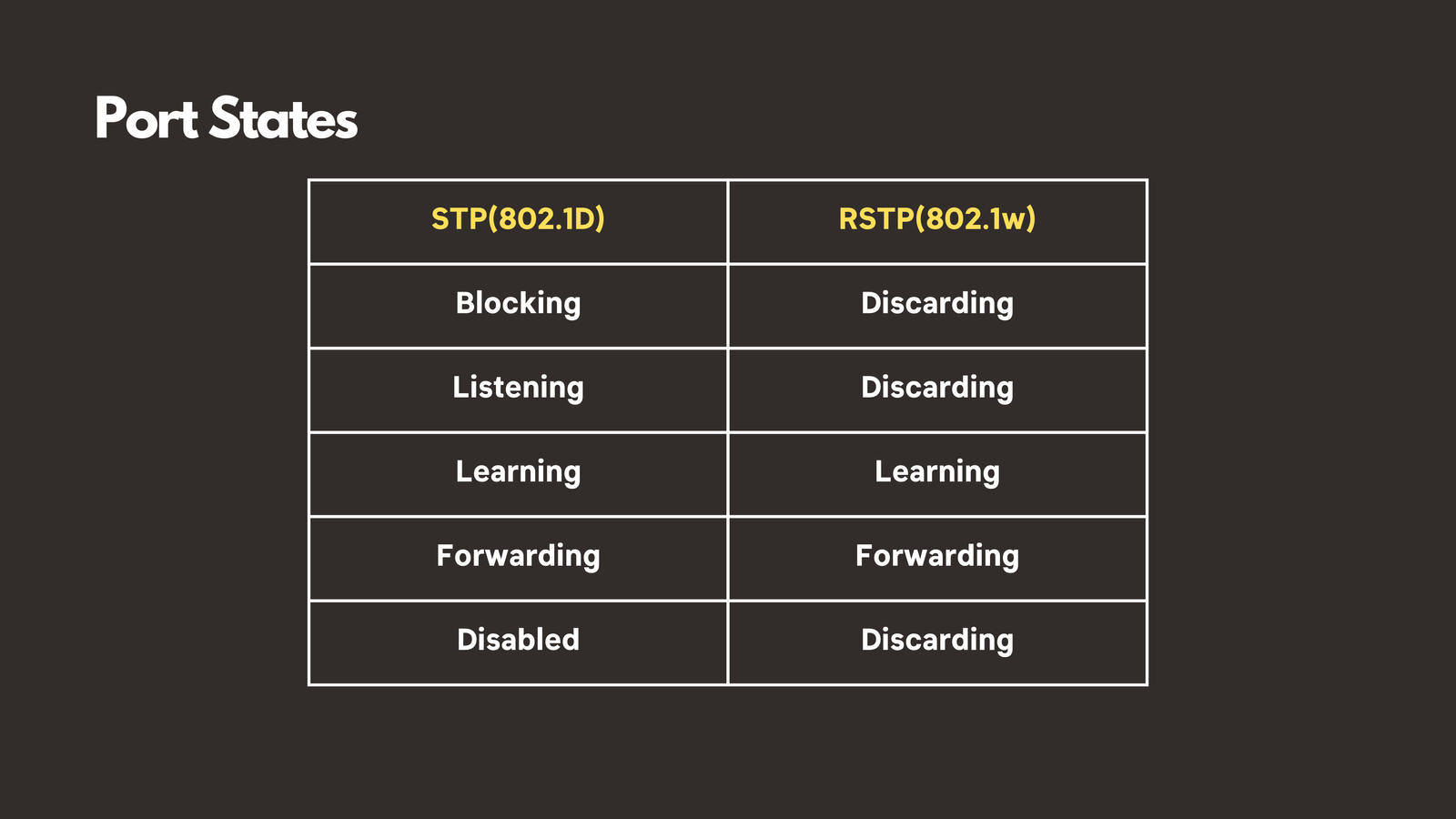
 Port States:
- Blocking/Discarding: Receives BPDUs, doesn’t forward traffic
- Listening: Prepares to forward, processes BPDUs
- Learning: Builds MAC address table, doesn’t forward
- Forwarding: Actively forwards traffic
- Disabled: Administratively shut down
STP Enhancements for Modern Networks
Several enhancements optimize STP for specific scenarios:
PortFast: Bypasses STP states on access ports connecting end devices, enabling immediate connectivity for workstations and servers.
BPDU Guard: Automatically shuts down PortFast-enabled ports that receive BPDUs, preventing potential loops from rogue switches or bridges.
BPDU Filter: Prevents BPDU transmission on PortFast ports, useful in specific deployment scenarios.
Root Guard: Prevents inferior BPDUs from making a port become the root port, maintaining intended root bridge placement.
Loop Guard: Prevents alternate or backup ports from becoming designated ports due to unidirectional link failures.
Security Considerations: Port Security
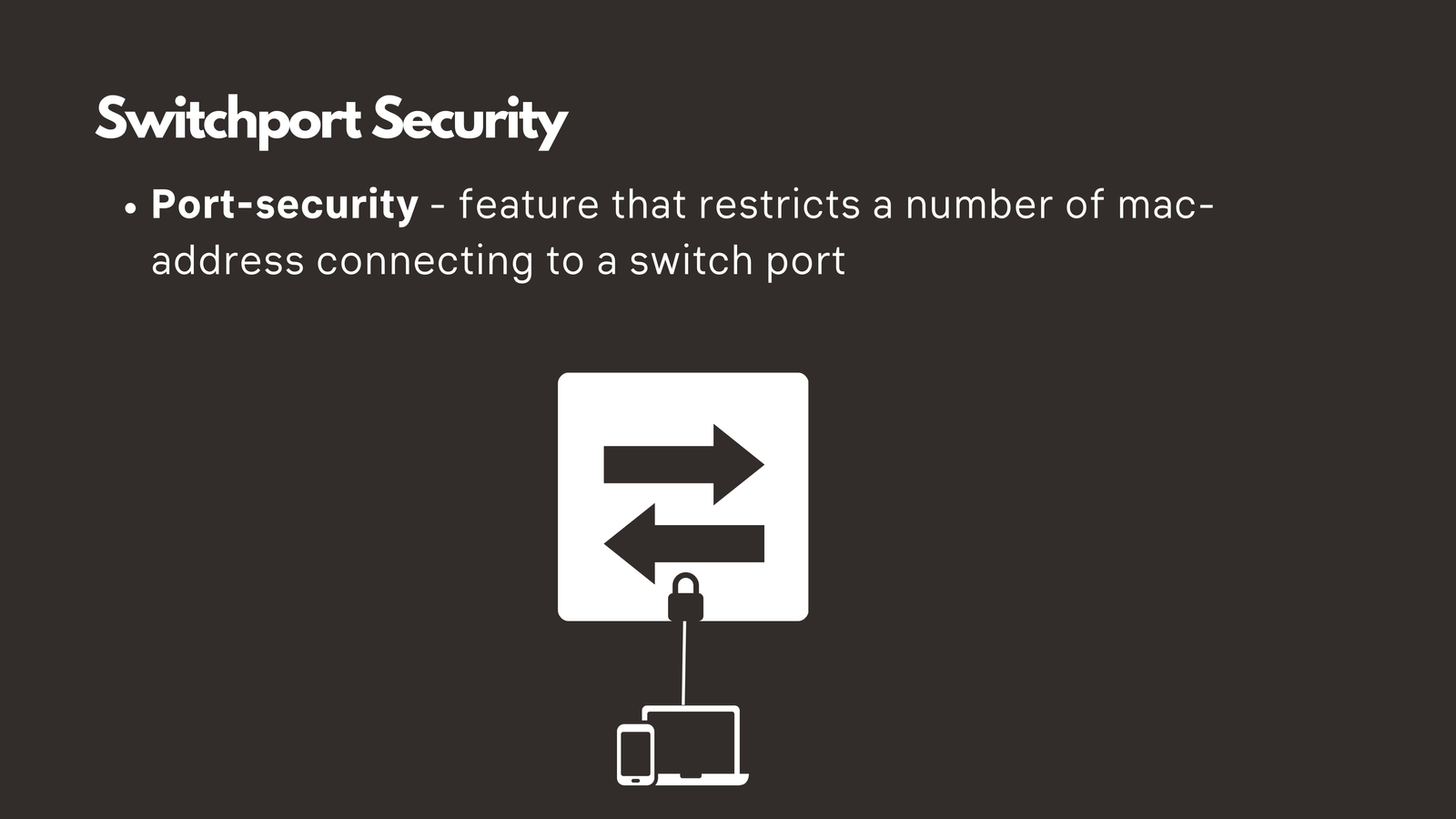
Network security begins at the access layer with port security features that control which devices can connect to switch ports. Port security provides the first line of defense against unauthorized network access by limiting and controlling MAC addresses allowed on each port.
Putting It All Together
These Layer 2 technologies work together to create robust, scalable network infrastructures. VLANs provide logical segmentation, trunk links enable efficient inter-switch communication, EtherChannel multiplies bandwidth and provides redundancy, and spanning tree prevents catastrophic loops.
Understanding how these technologies interact is crucial for designing, implementing, and troubleshooting modern networks. Whether you’re building a small office network or a large enterprise infrastructure, mastering these fundamentals will serve as the foundation for your networking expertise.
As network demands continue to evolve, these Layer 2 technologies remain as relevant as ever, providing the stable, high-performance foundation that modern businesses depend on for their critical operations.
Ready to dive deeper into network switching? Checkout the video on this link https://youtu.be/JB9h7MVOqYM